
Short answer: Angi’s cost guide, updated in September 2026, puts the national average cost to install a home EV charger at about $967, with most homeowners paying $554 to $1,380. A Level 2 charger with installation typically runs $700 to $2,000 or more. The biggest swing factors are whether your panel has room for a new 240 volt circuit and how far that circuit has to run. These are national figures, not our prices; the only reliable number for your home is a quote based on a look at your panel and parking spot.
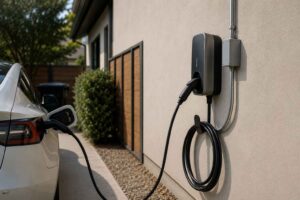
EV Charger Installation Cost Breakdown
Angi breaks the cost into these parts (national figures, updated September 2026):
| Item | Typical cost (Angi) |
|---|---|
| Level 1 charger equipment | $300 to $600 |
| Level 2 charger equipment | From about $300 to over $1,000 |
| Professional installation | $400 to $1,200 |
| New wiring run (for example, panel to garage) | $500 to $1,500 |
| Panel upgrade or added capacity, if needed | $800 to $2,000 |
| Permit | About $100 to $200 |
Most homes do not need every line on that list. A garage with the panel on the same wall and spare capacity is a small job. A detached garage, a full panel or an older service can add several of these items.
Level 1 vs. Level 2: What You Are Paying For
Level 1 uses a standard 120 volt outlet and the cord that usually comes with the car. It is slow but often enough for short daily commutes, and it may need nothing more than a sound outlet on a circuit that is not shared with other heavy loads.
Level 2 runs on 240 volts and charges much faster. It needs its own circuit, either to a NEMA 14-50 outlet for a plug-in charger or hardwired to the charger. The electrical code treats EV charging as a continuous load, so the circuit has to be rated for at least 125 percent of what the charger draws: a charger set to 40 amps needs a 50 amp circuit, and one set to 48 amps needs a 60 amp circuit. Our Level 1 vs Level 2 guide compares the two in more detail.
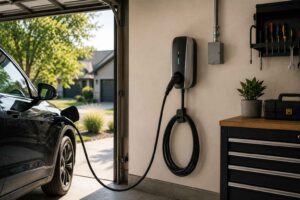
What Drives the Cost Up or Down
- Panel capacity. A Level 2 circuit adds a large continuous load. If the panel has no space or the service is already close to its limit, you may need a load calculation, a panel upgrade or a load management device. See when to replace an electrical panel.
- Distance and route. The farther the charger is from the panel, and the harder the route through walls, attics or outside, the more wire and labor.
- Plug-in or hardwired. A plug-in charger on a 14-50 outlet is easy to replace. A hardwired charger can run at a higher current but needs a larger circuit.
- Indoor or outdoor. Outdoor installs need weather-rated equipment and wiring methods.
- Permits. Many cities require a permit for a new circuit. Ask whether your job needs one and who will pull it.
- The charger itself. Smart features, higher amperage and longer cables cost more.
Tax Credits and Rebates
The federal tax credit for home chargers (Section 30C), which covered 30 percent of the cost up to $1,000, applied to property placed in service through June 30, 2026, so a charger installed now generally does not qualify. Check with your electric provider for any current programs, and confirm tax questions with a tax professional.
How to Get an Accurate Quote
- Know your car’s maximum charging rate and how many miles you drive on a typical day.
- Take a photo of your panel label and the breaker layout.
- Decide where you want the charger and where the car parks.
- Ask whether the quote includes the circuit, the outlet or hardwiring, the permit, and any panel work.
- Check the contractor’s license with TDLR’s license search.
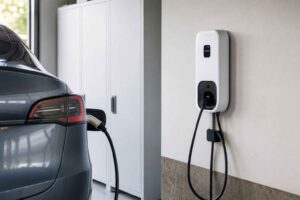
Frequently Asked Questions
How much does it cost to install an EV charger at home?
Angi’s September 2026 figures put the national average at about $967, with most homeowners paying $554 to $1,380. Level 2 installs commonly run $700 to $2,000 or more, depending on the panel and the wiring run.
Does a Level 2 charger need a panel upgrade?
Not always. It depends on whether the panel has space and enough capacity for a continuous 240 volt load. A load calculation answers that.
How long does installation take?
A simple install near the panel can often be done in a few hours. Long wiring runs or panel work take longer.
Do I need a permit to install an EV charger in Texas?
It depends on where you live. Many cities require a permit for a new circuit. Ask your electrician or your city’s building department.
Can I use a 50 amp RV outlet for my EV?
A 50 amp RV outlet is usually a NEMA 14-50, the same type many plug-in chargers use, so it can often serve both. See our guide to 50 amp RV outlet installation.
EV Charger Installation in Abilene
For installation in Abilene or the nearby towns we serve, see our EV charger installation page or call (325) 326-5306. We check your panel first, then explain what the job needs before any work starts.