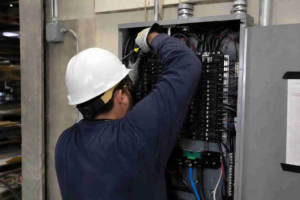
Short answer: a commercial electrician is a licensed electrician who installs, maintains and repairs electrical systems in businesses and other non-residential buildings, such as offices, shops, restaurants, warehouses, churches and schools. The work is similar in principle to home wiring, but the systems are larger, often run on three-phase power, are built with different materials, and have to meet the code requirements that apply to buildings the public and employees use every day.
This guide explains what commercial electricians do, how their work differs from residential work, which licenses matter in Texas, and what to check before you hire one.
What Does a Commercial Electrician Do?
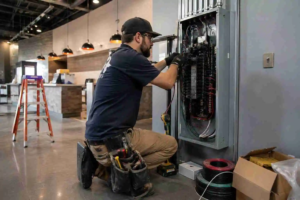
The day-to-day work covers the whole life of a building’s electrical system:
- New construction and tenant finish-out: laying out and installing power, lighting and equipment circuits for a new building or a newly leased space.
- Service and distribution: installing and upgrading service equipment, panels, transformers and feeders so the building has enough capacity for its equipment.
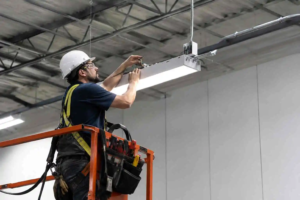
- Lighting: interior and parking lot lighting, lighting controls, and the emergency and exit lighting a building needs if the power fails.
- Equipment connections: wiring HVAC units, commercial kitchen equipment, compressors, motors, signs and other dedicated loads.
- Troubleshooting and repair: tracking down tripping breakers, overheating connections, power quality problems and equipment that will not start.
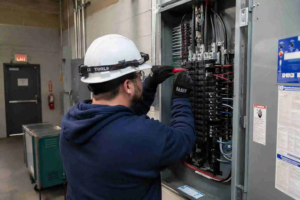
- Maintenance and inspections: checking panels and connections, correcting code issues found during an inspection, and keeping records up to date.
- Backup power and EV charging: standby generators, transfer equipment and parking lot EV chargers.
Commercial vs. Residential Electrician: What Is the Difference?
Both work under the same state electrical code, but the jobs look quite different in practice.
| Residential | Commercial | |
|---|---|---|
| Typical buildings | Houses, duplexes, apartments | Offices, retail, restaurants, warehouses, schools, churches |
| Power supply | Usually single-phase 120/240 volt | Often three-phase, such as 120/208 or 277/480 volt |
| Wiring methods | Mostly nonmetallic sheathed cable in wood framing | Often conduit or metal-clad cable, in steel framing or exposed ceilings |
| Loads | Appliances, HVAC, lighting | Large HVAC, motors, kitchen equipment, long lighting runs |
| Extra requirements | Dwelling-specific protections such as AFCI and GFCI | Emergency and exit lighting, workplace safety rules, more involved plan review and inspection |
Many electricians do both kinds of work, but a commercial job calls for someone who is comfortable with three-phase systems, larger equipment and the paperwork that comes with them. For homes, see our residential electrical services.
Licensing: What Texas Requires
In Texas, electricians and electrical contractors are licensed by the Texas Department of Licensing and Regulation (TDLR). A few points are worth knowing before you hire anyone for commercial work:
- Not every license covers commercial work. A Residential Wireman license, for example, is limited to single-family and multifamily dwellings not exceeding four stories. Commercial installations are done by journeyman and master electricians, with apprentices working under supervision, for a licensed electrical contractor.
- Electrical contractors must have a master electrician. Under Texas law, a licensed electrical contractor must be, or employ, a master electrician.
- Contractors must carry liability insurance. TDLR rules require electrical contractors to carry general liability insurance of at least $300,000 per occurrence and $600,000 aggregate, plus products and completed operations coverage.
- The state code is the NEC. Texas adopts the National Electrical Code as the state electrical code, and TDLR adopted the 2026 edition effective September 1, 2026. Cities can also have their own permit and inspection requirements.
When Does a Business Need a Commercial Electrician?
- Breakers trip regularly, or equipment shuts down when other equipment starts.
- Panels, breakers or connections feel warm, buzz or show discoloration.
- Lights flicker across the building, or a section loses power with no obvious cause.
- You are adding equipment, such as a walk-in cooler, a compressor, a new HVAC unit or EV chargers.
- You are moving into, expanding or remodeling a space.
- A fire marshal, insurer or building inspector has flagged electrical issues.
- Exit signs or emergency lights are not working when tested.
Problems in a workplace affect employees and customers, not just the owner. OSHA’s electrical safety pages are a useful reference for the hazards involved.
How to Choose a Commercial Electrician
- Check the license. Look up the contractor and the electricians on the job with TDLR’s license search.
- Ask for a certificate of insurance naming your business, before work starts.
- Ask who pulls the permit and whether the job will be inspected.
- Get the scope in writing. A clear written scope makes quotes comparable and avoids surprises.
- Ask about scheduling around your hours. Many businesses need work done before opening, after closing or in stages so they can stay open.
- Ask how emergencies are handled. Find out how to reach them if power fails during business hours or overnight.
Frequently Asked Questions
What is a commercial electrician?
A licensed electrician who installs, maintains and repairs electrical systems in businesses and other non-residential buildings.
What is the difference between a commercial and a residential electrician?
Residential electricians mostly work on single-phase systems in homes. Commercial electricians work in larger buildings that often use three-phase power, conduit and heavier equipment, with added requirements such as emergency and exit lighting.
Can a residential electrician do commercial work in Texas?
It depends on the license. A Texas Residential Wireman is limited to dwellings of four stories or less, so commercial jobs are done by journeyman and master electricians working for a licensed electrical contractor.
How do I check if a commercial electrician is licensed in Texas?
Use the TDLR license search and look up the contractor’s business name or the individual electrician’s name.
Do commercial electricians handle emergencies?
Many do, because a power failure can shut a business down. Ask any contractor you are considering how to reach them after hours.
How much does a commercial electrician cost?
It depends on the job, the equipment and the hours involved. Ask for a written quote based on a site visit and a clear scope of work.
Need a Commercial Electrician in Abilene?
If your business is in Abilene or one of the nearby towns we serve, call (325) 326-5306 and tell us what is going on. See our commercial electrical services, including electrical contracting, commercial wiring and security lighting. For urgent problems, see our emergency electrician page.