
The short answer: a smoke detector chirping once every 30 or 60 seconds almost always means the battery is low and needs to be changed. If the chirping keeps going after you put in a fresh battery, the alarm usually needs a reset or has reached the end of its life. The National Fire Protection Association says all smoke alarms must be replaced 10 years after the manufacturing date (NFPA). One thing comes first, though: a chirp is not the same as an alarm. A continued set of three loud beeps means smoke or fire. Get out, call 911 and stay out.
Below: what each chirp usually means, how to stop it safely, and when a hardwired alarm that keeps chirping points to an electrical problem. NFPA says working smoke alarms cut the risk of dying in a home fire by 60 percent. In a CPSC survey published in September 2024, 13 percent of the alarms tested in homes worked only after a battery problem was fixed, and 9 percent did not work even after that.
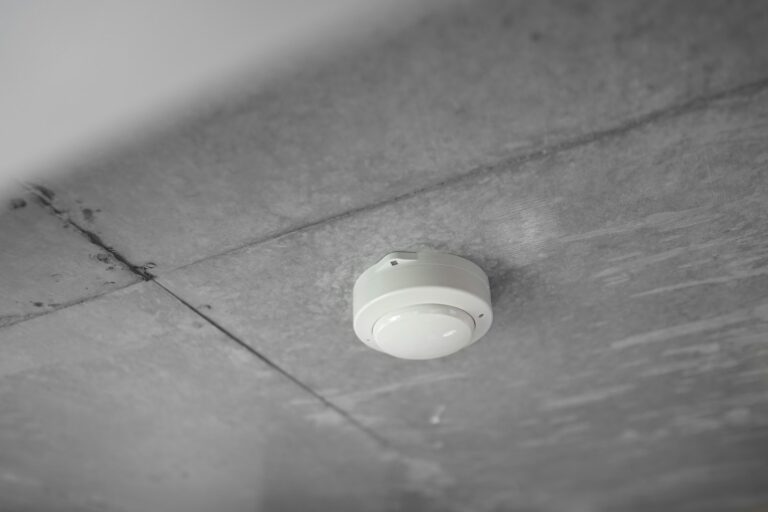
Chirp or Alarm? What the Sounds Mean
Patterns vary by brand and model, so your owner’s manual is the final word. These are the common ones, from NFPA’s smoke alarm FAQ, the Texas Department of Insurance (July 2025), Kidde and First Alert (April 2025).
| What you hear | What it usually means | What to do |
|---|---|---|
| Three loud beeps that keep repeating | Smoke or fire | Get out, call 911 and stay out. |
| Four beeps that keep repeating, from a CO or combination alarm | Carbon monoxide | Move to fresh air outdoors or by an open door or window and call for help from there (NFPA). |
| One chirp every 30 to 60 seconds | Low battery | Replace the battery, then press the test button. |
| Chirping that goes on after a new battery | Leftover charge, a battery that is not seated, or an alarm at the end of its life | Reset the alarm and check the date on the back. |
| A chirp every 30 seconds from an alarm with a sealed 10-year battery | End of life | Replace the whole alarm. |
| Three chirps a minute from a combination smoke and CO alarm | Often a malfunction | Replace the alarm. |
| Chirps every 30 to 40 seconds right after you press Hush | Hush mode on some Kidde models | Nothing. It stops after about seven minutes. |
Why Is My Smoke Detector Chirping? The Common Causes
- A low battery. The most common cause. TDI says a single chirp means the battery is low or the detector should be replaced, and recommends new batteries once a year.
- A weak battery on a cool night. Kidde explains that a weak battery has higher internal resistance and a cooler room makes it worse. Most homes are coldest between 2 a.m. and 6 a.m., so a weak battery often starts chirping then and may stop once the house warms up (Kidde).
- An old alarm. Smoke alarms wear out. Kidde says smoke alarms should be replaced every 10 years and carbon monoxide or combination alarms every 7 years. The date is printed on the back of the unit (Kidde).
- Steam, drafts and temperature. Kidde lists humidity and steam, an air vent, ceiling fan or open window within three feet of the alarm, and room temperatures outside the alarm’s range as causes of on and off chirping. Kidde rates its smoke alarms for 40 to 95 degrees Fahrenheit.
Smoke Detector Chirping After a New Battery
The cause is usually simple. First Alert lists these:
- The battery is in backward or is not making full contact.
- The battery drawer is not fully closed, or the alarm is not fully seated on its bracket.
- The battery is the wrong type for that model. Use the size and type printed on the alarm’s label.
- Leftover charge is keeping the warning active. Kidde adds that the alarm can hold on to a weak battery error after the battery is replaced. A reset clears it.
- On a hardwired alarm, the trouble can be the power, not the battery: a loose connector, a power interruption or a tripped breaker.
- The alarm has expired. A new battery will not stop an end-of-life warning.
NFPA’s own guidance is short: if the chirping continues after the battery has been replaced, the alarm is at the end of its life and the unit must be replaced.

How to Stop a Smoke Detector From Chirping
These steps are for a chirp, not a full alarm, and follow the reset steps First Alert and Kidde publish. Check your model’s manual too.
- Find the right alarm. Stand under each one until you find the chirping unit.
- Check the date on the back. If the alarm is 10 years old or more (7 for a combination smoke and CO alarm), or you cannot read the date, replace the whole alarm instead of the battery.
- Replace the battery with the type on the label, facing the right way, and close the drawer all the way.
- Reset it if it still chirps. Take the battery out, press and hold the test button for 15 to 20 seconds to drain leftover charge, then put the battery back (First Alert reset guide). Kidde gives 15 seconds for its alarms.
- Test it. Press the test button and listen for the loud beep, beep, beep. NFPA says to test every alarm once a month.
For a hardwired alarm with a backup battery, First Alert and Kidde add a step at each end: turn off the breaker for the alarm circuit first, and turn it back on at the end. In between, take the alarm off its bracket, unplug its connector only if your model is designed for that, remove the backup battery and hold the test button. If you need a refresher on breakers, see how to reset a breaker safely. Do not remove the mounting plate or touch the wires in the ceiling box.
Do not leave the battery out or take an alarm down just to stop the noise. In the CPSC survey, removed batteries and disconnected alarms were among the reasons households gave for alarms that did not work.
Hardwired Smoke Detector Chirping: When It Is an Electrical Problem
Hardwired alarms run on your home’s wiring with a battery as backup, so a chirp that survives a new battery and a reset can come from the electrical side. Kidde names several causes:
- A loose neutral wire. Kidde says a loose white neutral wire can cause an echoing chirp from one unit to the next.
- Power dips and surges. Power interruptions, surges and utility switching can set off chirps, and so can an exhaust fan, attic fan or heater on the same circuit switching on. For hardwired units, Kidde’s advice is to have an electrician investigate, and it notes that putting alarms on a dedicated circuit can reduce these problems. See what a dedicated circuit is and our guide to whole house surge protectors.
- A tripped breaker or loose connector. First Alert lists a tripped circuit and a loose connector at the back of the alarm as reasons a hardwired alarm keeps chirping.
- Mismatched alarms. Interconnected alarms are meant to work as a set. Kidde says connecting its alarms to equipment it has not specified could cause nuisance alarms, failure to alarm or damage to the devices (Kidde).
Call an electrician when a hardwired alarm keeps chirping after a new battery and a reset, when several alarms chirp or sound with no smoke, when the alarm breaker trips, or when the chirps line up with a fan or heater turning on. An electrician can trace the circuit, fix connections and replace old units with compatible ones. NFPA recommends interconnected alarms throughout the home, so that when one sounds they all sound, and notes that they can be installed by a qualified electrician. We handle this as part of our electrical installation work. Buying an older home? See our post on home electrical inspections.
Renters, Free Alarms and Outages in the Abilene Area
- Renters. Under the Texas Property Code, a landlord does not have to supply batteries for a battery-operated alarm after you move in if it worked when you took possession, but must inspect and repair an alarm after you report a problem (Tex. Prop. Code 92.258). This is a summary, not legal advice.
- Free alarms. The Texas State Fire Marshal’s Office lists the Abilene Fire Department as providing free smoke alarm installation to homeowners who qualify (TDI list, updated May 2026).
- After a power outage. When AEP Texas or Taylor Electric Cooperative power goes out, hardwired alarms with a backup battery run on that battery, and Kidde lists interrupted power as a cause of chirping. If the chirp starts after an outage, replace the backup battery and reset. Our power outage electrical safety checklist has outage numbers for both utilities.
Frequently Asked Questions
Why is my smoke detector chirping with no battery?
If the alarm has no battery door, it probably has a sealed 10-year battery. Kidde says those alarms chirp every 30 seconds when it is time to replace the whole unit. If it is a hardwired alarm, check whether its backup battery is missing or dead and whether its breaker is on. A hardwired alarm that keeps chirping after that needs an electrician.
How long will a smoke detector chirp before the battery dies?
Kidde says its alarms chirp every 30 to 40 seconds, or every 60 seconds on some models, for at least seven days when the battery is low. Replace the battery the day it starts.
What does it mean when a smoke detector chirps three times?
Three loud beeps that keep repeating is the smoke or fire alarm: get out and call 911. Three short chirps about once a minute from a combination smoke and carbon monoxide alarm often means a malfunction, and First Alert says to replace that alarm. When in doubt, treat the sound as real until you know there is no danger.
Do I need an electrician to replace a hardwired smoke detector?
If you are replacing an alarm with a compatible one that plugs into the existing connector, follow the manufacturer’s instructions and turn the breaker off first. Changing brands, adding new alarms, running wire to interconnect them, or fixing chirping that comes from the wiring is electrician work.
Hardwired Alarm Still Chirping?
If a hardwired smoke detector keeps chirping after a new battery and a reset, or you want interconnected alarms added, call (325) 326-5306. We work in Abilene and the nearby towns, including Dyess AFB, Tye, Merkel, Clyde, Potosi, Buffalo Gap and Tuscola. For anything urgent, see our emergency electrician page. If an alarm is sounding a full alarm, get out and call 911 first.