
Short answer: rewiring a whole house usually costs several thousand dollars at the low end and can run well into five figures for a large or older home. Published cost guides do not agree on the exact range, because every house is different. Angi’s 2026 cost guide puts most whole-house rewires at about $2 to $4 per square foot including materials and labor, while HomeGuide puts the average at $5 to $17 per square foot. The only number that matters for your home is a written quote based on an in-person look at the wiring.
This guide explains what those ranges mean, why they are so far apart, what pushes the price up or down, and how to get an estimate you can compare.
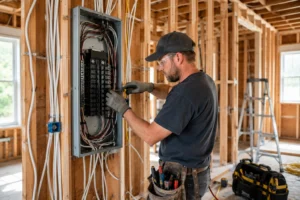
Published Cost Ranges for Rewiring a House
These figures come from two national cost guides. They are national estimates, not prices from us, and local labor rates and your home’s condition can put your number above or below them.
| Home size | Angi (updated August 2026) | HomeGuide |
|---|---|---|
| 1,000 sq ft | $2,000 to $4,000 | $5,000 to $17,000 |
| 1,500 sq ft | $3,000 to $6,000 | $7,500 to $25,500 |
| 2,000 sq ft | $4,000 to $8,000 | $10,000 to $34,000 |
| 3,000 sq ft | $6,000 to $12,000 | $15,000 to $51,000 |
Both guides also list related costs. Angi gives $900 to $2,000 for a 100 amp panel upgrade and $1,500 to $2,500 for 200 amps, and says a whole-house rewire typically takes three to ten days. HomeGuide puts replacing an electrical panel at $850 to $2,500 and replacing knob and tube wiring at $12,000 to $35,000.
Why Rewiring Estimates Vary So Much
A per-square-foot number hides most of what actually drives the cost. Two houses of the same size can be priced very differently because of:
- Access to the walls and ceilings. Rewiring during a remodel with open walls is much faster than fishing new wire through finished walls, which takes more labor and leaves openings to patch.
- Attic and crawl space access. Roomy attics and crawl spaces make it easier to run new circuits. Tight or inaccessible spaces add time.
- The age and type of the existing wiring. Knob and tube, cloth-covered cable and aluminum branch wiring usually mean more removal and more connections to replace.
- Whether the panel is replaced too. Many older homes need a new panel or a service upgrade to support modern loads, which adds to the total.
- How many circuits and devices you add. Most rewires are a chance to add outlets, dedicated circuits and lighting, and each adds material and labor.
- Code requirements. New work has to meet the current code. Texas adopted the 2026 National Electrical Code effective September 1, 2026, and a rewire brings in protections such as GFCI and AFCI where the code requires them.
- Permits, inspections and repairs. Permit fees, inspection visits and drywall patching and painting are often quoted separately, so check what is included.
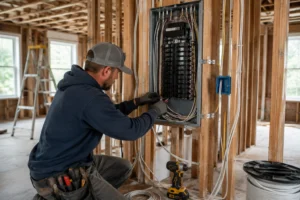
Cost to Rewire an Old House
Older homes tend to land at the higher end of any range. The reasons are practical: old wiring often has to be traced and removed or abandoned safely, plaster walls are harder to open and repair than drywall, and the existing panel is often too small. Some homes have aluminum branch wiring; the U.S. Consumer Product Safety Commission says it was installed between 1965 and the mid 1970s and that its connections can overheat. Aluminum wiring does not always mean a full rewire, since CPSC also describes repair methods for the connections, so ask an electrician to explain the options and the cost of each.
Full Rewire vs. Partial Rewire
Not every home needs every wire replaced. A partial rewire focuses on the parts of the house or the circuits that need it most, such as an old kitchen, a few failing circuits, or a room being remodeled. It costs less up front and can be done in stages. A full rewire makes more sense when the wiring type itself is the problem, when many circuits show signs of trouble, or when the house is being gutted anyway.
Rewiring a kitchen
Kitchens are the most common partial rewire, because they carry the heaviest loads in a home. The electrical code requires at least two 20 amp small-appliance circuits for kitchen countertop outlets, GFCI protection for those outlets, and dedicated circuits for many fixed appliances. An older kitchen wired before these requirements often needs new circuits, not just new outlets. Kitchen costs vary with the number of circuits, the appliances and the wall access, so get a quote based on your layout.
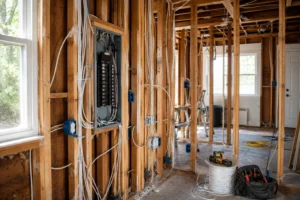
Signs Your House May Need Rewiring
- Breakers that trip often under normal use. See why a breaker keeps tripping.
- Lights that flicker or dim in several rooms. See how to fix flickering lights.
- Outlets or switch plates that feel warm, or a burning smell. See is it dangerous if a plug gets warm.
- Two-prong outlets with no ground, or very few outlets and lots of extension cords.
- Knob and tube, cloth-covered or aluminum branch wiring. Our guide to types of wiring in old houses shows how to recognize them.
- An old or undersized panel. See when to replace an electrical panel.
How to Get an Accurate Rewiring Quote
- Get an in-person inspection. Nobody can price a rewire properly from square footage alone.
- Ask for a written scope. It should list the circuits, devices and any panel or service work included.
- Ask what is excluded. Drywall and plaster repair, painting, permit fees and fixture costs are common exclusions.
- Ask about phasing. If the budget is tight, ask which circuits should be done first.
- Check the license. In Texas, electrical work is licensed by TDLR, and you can look up a contractor with TDLR’s license search.
- Compare like with like. Line the quotes up by scope, not just total price.
Should You Rewire a House Yourself?
A rewire involves the service, the panel and every circuit in the house, and mistakes may not show up until months later as overheating connections or tripping breakers. It is also work that normally needs a permit and inspection. Even where a homeowner exemption might apply, this is a job for a licensed electrician.
Frequently Asked Questions
How much does it cost to rewire a house?
National cost guides disagree. Angi’s 2026 guide puts most whole-house rewires at about $2 to $4 per square foot, and HomeGuide puts the average at $5 to $17 per square foot. Your home’s age, wall access, panel and the number of circuits decide where you land.
How long does it take to rewire a house?
Angi says a whole-house rewire typically takes three to ten days. Larger homes, plaster walls and panel or service upgrades can take longer.
Does rewiring include a new electrical panel?
Not always. Many older homes need one, and it is usually priced as a separate line item. Ask whether the quote includes the panel and any service upgrade.
Can you rewire a house without removing drywall?
Often, yes. Electricians can fish new cable through walls from the attic, crawl space or small openings. Some patching is still normal, and the amount depends on the house.
Does homeowners insurance pay for rewiring?
Policies usually do not cover upgrades to old wiring. Some insurers ask about older wiring types, such as knob and tube or aluminum, when writing a policy. Check your own policy.
Thinking About Rewiring in Abilene?
If you are in Abilene or one of the nearby towns we serve, call (325) 326-5306 to arrange a look at your wiring and a written quote. See our electrical installations and panel upgrade services.