
Short answer: start by looking at how much is flickering. If it is one bulb, the fix is usually the bulb itself, a loose bulb or a dimmer that does not get along with LED bulbs. If one room or one circuit flickers, the switch, the fixture or a loose connection on that circuit is the likely cause. If lights all over the house flicker or dim, the problem is bigger, either in your main electrical service or on the utility side, and it needs a professional.
Below is a quick way to narrow it down, the fixes that are safe to try yourself, and the signs that mean you should stop and call an electrician.
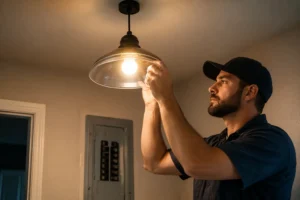
Why Are My Lights Flickering? A Quick Diagnosis
| What you see | Most likely cause | What to do |
|---|---|---|
| One bulb flickers | Loose or failing bulb, or a bulb that is not rated for the fixture or dimmer | Tighten or replace the bulb (steps 1 to 3 below) |
| Flickers only when dimmed | Dimmer and LED bulb are not compatible | Use dimmable bulbs and a dimmer made for LEDs (step 4) |
| Flickers when you touch the switch | Worn switch or loose wire at the switch | Have the switch replaced and the connections checked |
| Lights dim briefly when the AC or a large appliance starts | A large motor drawing a burst of current as it starts | A short dip can be normal; repeated or deep dimming should be checked (step 5) |
| Several lights or a whole room flicker | Loose connection on that circuit or an overloaded circuit | Call an electrician |
| Lights all over the house flicker, or some get brighter while others dim | Problem in the main service, such as a loose neutral, or on the utility side | Call your utility and an electrician promptly (step 6) |
7 Ways to Fix Flickering Lights
1. Turn the light off and tighten the bulb
A bulb that has worked slightly loose in its socket loses good contact and flickers. Switch the light off, let the bulb cool, and turn it gently clockwise until it is snug. Do not overtighten it.
2. Swap in a bulb you know works
Bulbs fail, and cheap LED bulbs in particular can flicker as their internal electronics wear out. If a different bulb solves the problem, you are done.
3. Check that the bulb suits the fixture
Bulbs in enclosed fixtures, ceiling fans and outdoor fixtures run warmer. Use a bulb whose packaging says it is suitable for that kind of fixture, and stay within the fixture’s wattage rating.
4. Match LED bulbs to the dimmer
This is one of the most common causes of flicker in homes that switched to LEDs. Older dimmers were designed for incandescent bulbs, and many LED bulbs either are not dimmable or do not work well with those dimmers, which shows up as flickering, buzzing or lights that will not dim smoothly. Check that the bulbs say “dimmable”, and check the dimmer maker’s compatibility list. The National Electrical Manufacturers Association suggests using bulbs and dimmers that both carry its dimming compatibility logo. If the dimmer is old, replacing it with one made for LED loads often fixes the problem.
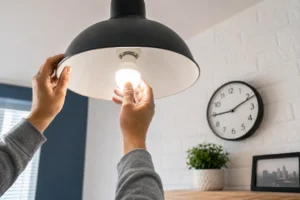
5. Watch what else is running
Notice whether the flicker lines up with something else turning on, like the air conditioner, a well pump, a microwave or a space heater. A brief dip as a big motor starts can be normal. If the lights dim deeply, stay dim, or flicker every time the same appliance runs, the circuit may be overloaded or a connection may be loose, and an electrician should look at it. If the same circuit’s breaker also trips, read why a breaker keeps tripping.
6. Check whether it is the whole house, or the whole street
If lights in every room flicker, ask a neighbor whether theirs are doing the same. If they are, the problem is probably on the utility’s side. In Abilene, the power lines are run by AEP Texas; in many rural parts of Taylor County they are run by Taylor Electric Cooperative. Your bill shows which one serves you. If it is only your house, the problem may be in your main panel, meter base or service connection. Whole-house flicker, especially when some lights get brighter while others dim, can point to a loose neutral connection, which can damage appliances and electronics. Treat it as urgent.
7. Know when to stop
If the steps above do not fix it, the remaining causes are inside switches, fixtures, junction boxes or the panel. That is the point to stop and call an electrician rather than opening things up.
When Flickering Lights Are a Warning Sign
Call an electrician promptly, and stop using the affected lights, if the flickering comes with any of these:
- a burning smell, or a switch, outlet or cover plate that feels warm;
- buzzing, crackling or sparks at a switch, outlet or fixture;
- flickering in several rooms, or lights that get brighter while others dim;
- a breaker that keeps tripping on the same circuit;
- a home with aluminum branch wiring.
The last point matters for some older homes. The U.S. Consumer Product Safety Commission says aluminum branch circuit wiring was installed in homes between 1965 and the mid 1970s, and it lists flickering lights among the warning signs of overheating aluminum connections, along with hot cover plates, dead circuits and the smell of burning plastic. If you are not sure what wiring your home has, our guide to types of wiring in old houses is a good starting point. If you notice a smell you cannot place, see what an electrical fire smells like.
What an Electrician Will Check
An electrician will usually start where the flicker is and work back toward the panel: the bulb and socket, the switch or dimmer, connections in the fixture and boxes along the circuit, the breaker and its connection in the panel, and finally the main service and neutral. For whole-house problems they may coordinate with the utility, since problems on the lines feeding your home are the utility’s to fix. The fix can be as simple as a new dimmer or a tightened connection, or it can point to a wider wiring issue that needs repair.
Frequently Asked Questions
Are flickering lights dangerous?
Not always. A loose bulb or a mismatched dimmer is a nuisance, not a hazard. Flickering that comes with heat, a burning smell, buzzing or tripping breakers, or that affects the whole house, can point to a loose connection and should be checked.
Why do my LED lights flicker?
Usually because the bulb is not dimmable, the dimmer was designed for incandescent bulbs, or the bulb’s internal driver is failing. Try a dimmable bulb and a dimmer made for LED loads.
Why do my lights flicker when the AC turns on?
A large motor draws extra current for a moment as it starts, which can cause a brief dip. If the dimming is deep, lasts more than a moment, or keeps getting worse, have the circuit and service checked.
What does it mean if all the lights in my house flicker?
Whole-house flickering points to the main electrical service or the utility, not a single bulb or switch. Check whether neighbors are affected, contact your utility, and have an electrician check your panel and service connection.
Can I fix a flickering light switch myself?
You can try the bulb and dimmer checks above without opening anything. If the switch itself is the problem, replacing it means working on wiring, which is safer to leave to an electrician, especially in older homes. Our guide on whether light switches go bad covers the signs.
Flickering Lights in Abilene?
If you are in Abilene or one of the nearby towns we serve, call (325) 326-5306 and describe what you are seeing. We handle lighting services and switch and outlet repair. If there is smoke or a burning smell that keeps getting stronger, call 911 first.