
The short answer: most full-size hot tubs need a dedicated 240-volt circuit, usually on a 40, 50 or 60 amp breaker, hard-wired in copper through a GFCI-protected disconnect at least 5 feet from the water. Smaller plug and play models run on 120 volts, but they still need their own 15 or 20 amp circuit with GFCI protection, and never an extension cord. Those are the hot tub electrical requirements that show up in manufacturers’ manuals (Jacuzzi, Master Spas). The exact numbers depend on the model, so read the installation manual before you buy.
This guide covers 120 versus 240 volt tubs, what the circuit includes, where the tub can go, permits in Abilene and what the wiring typically costs.

Hot Tub Electrical Requirements at a Glance
These items come up again and again in installation manuals. Your model’s manual has the final word.
| Requirement | What manuals typically call for | Source |
|---|---|---|
| Voltage | 240 volts for most full-size tubs; 120 volts for plug and play models | Jacuzzi |
| Breaker size | 40, 50 or 60 amps at 240 volts; 15 or 20 amps at 120 volts | Jacuzzi |
| Circuit | Dedicated, with no patio lights, appliances or other loads on it | Master Spas |
| GFCI protection | Required, often as a GFCI breaker or a spa panel with a built-in GFCI | Master Spas, Jacuzzi J-460 manual, ExpertCE |
| Disconnect | A switch or breaker that cuts the power, at least 5 feet from the spa and easy to reach | Master Spas, Jacuzzi J-460 manual |
| Wire | Copper only; one 50 amp spec calls for #6 AWG copper with at least a #10 AWG copper ground, in a four-wire circuit (two hots, neutral, ground) | Jacuzzi J-460 manual, Master Spas |
| Connection | Hard-wired, with no plug-in connection or extension cord | Jacuzzi J-460 manual |
| Installer | A qualified, licensed electrician, with the work approved by the local inspection authority | Master Spas, Jacuzzi J-460 manual |
120 Volt Plug and Play vs 240 Volt Hot Tubs
Plug and play tubs are simpler to set up, with trade-offs. Jacuzzi says a 110 volt tub has weaker heaters and pumps and can take up to 24 hours or more to reach temperature, while a 220/240 volt model heats about two to five degrees per hour. Bullfrog Spas says a 120 volt spa usually allows only one pump, and the heater and pumps can’t run at the same time (Bullfrog Spas).
Plug and play does not mean any outlet will do. Jacuzzi says 110 volt tubs need a dedicated 15 to 20 amp circuit, and one Cal Spas manual for a 120 volt model calls for:
- A dedicated line with a 15 amp breaker.
- GFCI protection, which it requires on every 120 volt spa.
- A weatherproof covered receptacle, at least 5 feet and no more than 10 feet from the inside wall of the spa.
- A cord no longer than 15 feet, never buried, and no extension cords.
Check any existing outdoor outlet against your manual before you count on it. Our guide to dedicated circuits shows how to tell whether an outlet shares its circuit with anything else.
For 240 volt tubs, Jacuzzi says an electrician is needed for the hookup. It adds that even with a 40 amp breaker, a 240 volt tub cannot run the jet pumps and heater at the same time, and suggests 50 or 60 amps if you want both.
What an Electrician Installs for a 240 Volt Hot Tub
- A breaker at the main panel, sized to the tub’s spec plate. If the panel has no room or not enough capacity, a subpanel or a panel upgrade may have to come first.
- The wire run in copper, sized to the amperage. On long runs, ExpertCE advises checking voltage drop, with about 3 percent as a common target, and going up a wire size if needed.
- A GFCI disconnect, often called a spa panel or hot tub disconnect box. ExpertCE says a listed two-pole GFCI breaker at the panel or a listed spa panel with built-in GFCI protection is commonly used. Master Spas says it should be readily accessible to people using the spa.
- Bonding. Metal parts around the tub, such as pump motors, ladders and drains, are connected together so they stay at the same voltage. Master Spas provides a bonding lug on the spa for this.
ExpertCE also says all 125 volt receptacles within 10 feet of a spa or hot tub need GFCI protection. Its guide is based on the 2023 NEC. Texas adopted the 2026 NEC as the state electrical code, effective September 1, 2026 (TDLR), so your electrician will confirm the details under the current code.
If the wire runs underground, the Railroad Commission of Texas says homeowners and contractors are required by law to call 811 at least two days before digging, and the call is free (Railroad Commission of Texas).
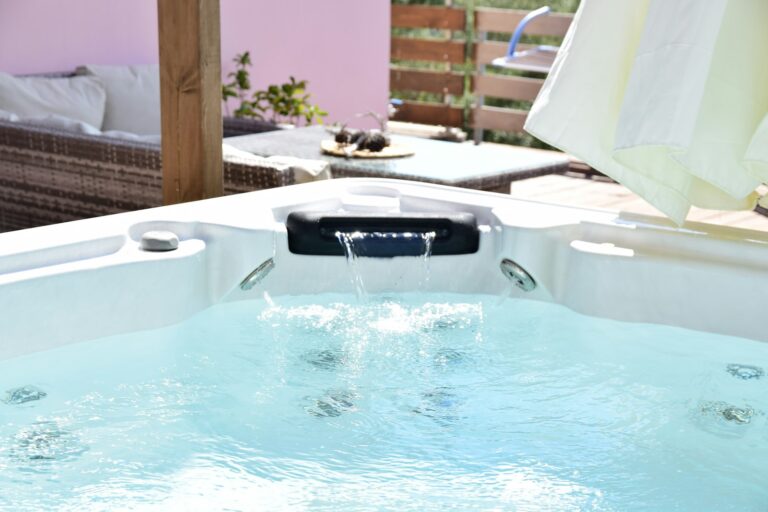
Choosing the Spot: Distance and Safety
- Keep cords and devices back. The Electrical Safety Foundation says electrical devices and cords should be kept at least 10 feet from water sources such as pools and spas (ESFI). NFPA suggests battery-operated devices where possible.
- Look up. ESFI says to make sure there are no power lines over a swimming pool. Use the same caution with a hot tub, and ask your electrician about overhead clearance.
- Know the shutoff. NFPA advises having a qualified electrician periodically inspect the electrical equipment for a pool, spa or hot tub, and asking them to show you how to shut off all power in an emergency (NFPA tips, via OH&S).
- Plan the disconnect spot. It must sit at least 5 feet from the water but stay easy to reach.
If anyone feels a tingle in the water, follow NFPA’s advice for swimmers: get out quickly and avoid metal ladders or rails. Then shut off the disconnect and keep everyone out until an electrician checks it.
Do You Need a Permit for a Hot Tub in Abilene?
For the electrical work, yes. The City of Abilene says a permit is required to install, alter or repair electrical systems. A homeowner can pull an electrical permit for their own home only after providing proof of a homestead exemption filed with the Central Appraisal District of Taylor County and passing a homeowner’s electrical test given by a City electrical inspector. Starting work without a permit is a code violation that brings a Stop Work Order and an investigation fee equal to the permit fee (City of Abilene FAQ). Building Inspections is at 325-676-6273. Outside city limits, check with your town or the county.
How Much Does Hot Tub Wiring Cost?
HomeAdvisor’s 2025 cost guide puts the average hot tub wiring job at $2,300, with a normal range of $1,900 to $4,200. If the main panel cannot handle the load, it lists $400 to $1,800 for a subpanel, and it puts electrician labor at $50 to $100 per hour. Wire and conduit are priced by length, so a tub close to the panel usually costs less to wire (HomeAdvisor).
These are national figures, not our price. We offer free estimates, and you approve the price before work starts. Our guide to how much an electrician costs explains labor rates.
When to Call an Electrician
Hot tub wiring is not a DIY job: the manuals call for a qualified or licensed electrician, and the City requires a permit. Call before you buy if your panel may be full, if you plan to use an existing outdoor outlet, or if you are moving a used tub or buying a house that has one (see our home electrical inspection guide). Once the tub is in, watch for these signs:
| What you notice | What it may mean | What to do |
|---|---|---|
| The GFCI trips after rain or heavy splashing | Moisture in the breaker box, which Jacuzzi lists as a common cause | Press reset once. If it trips again, leave it off and call an electrician. |
| The GFCI or breaker trips over and over | Jacuzzi lists heater problems, pump faults, loose or damaged wiring and a worn GFCI breaker | Stop resetting it and call an electrician. See why a GFCI keeps tripping. |
| A burning smell or damaged wiring at the disconnect | Jacuzzi says this calls for a professional | Do not touch it. If you see smoke or flames, get away and call 911. See what an electrical fire smells like. |
| A tingle when you touch the water | Possible current in the water, which NFPA warns about | Get out without touching metal rails, shut off the power at the disconnect and call an electrician. |
Frequently Asked Questions
What size breaker do I need for a hot tub?
It depends on the model. Jacuzzi suggests 40, 50 or 60 amps for 240 volt tubs, and Master Spas specifies a dedicated 50 amp breaker with GFCI for its 240 volt models. Plug and play tubs use a 15 or 20 amp circuit. Your tub’s spec plate and manual give the exact number.
What size wire do I need for a hot tub?
Wire size follows the breaker size and the length of the run. Master Spas calls for #6 AWG copper on its 50 amp circuit, and ExpertCE lists 6 AWG copper as typical for a 50 amp, 240 volt spa, with larger wire on long runs. Use copper only: Jacuzzi says not to use aluminum.
Does a hot tub need a GFCI?
Yes. The Master Spas, Jacuzzi and Cal Spas manuals all require GFCI protection, and Master Spas says to test it frequently before use. If it trips, our guide on how to reset a breaker safely explains when a reset is fine and when it is not.
Can I plug a hot tub into a regular outlet?
Only a 120 volt plug and play model, and only into an outlet that meets its manual: a dedicated circuit, GFCI protection, a weatherproof cover, the right distance from the tub and no extension cord.
Does a hot tub need a dedicated circuit?
Yes. Every manual cited here calls for one, at 120 or 240 volts. Master Spas says the circuit cannot serve other loads such as patio lighting, appliances or garage circuits.
Planning a Hot Tub in Abilene?
Call (325) 326-5306 before the tub is delivered, and we can check your panel and plan the circuit. Our licensed electricians work under a Texas electrical contractor license, in Abilene and the nearby towns, including Dyess AFB, Tye, Merkel, Clyde, Potosi, Buffalo Gap and Tuscola. New circuits are part of our electrical installation work, and we take 24/7 emergency calls through our emergency electrician page.